When E. Coli Learns to Mimic Nature's Pharmacy
I find it absolutely remarkable that we're living in an era where we can reprogram a humble bacterium like Escherichia coli to manufacture complex plant compounds that normally require acres of farmland and months of cultivation. This is precisely what Maarten Van Brempt and his colleagues accomplished in their 2022 study published in Microbial Cell Factories—they transformed E. coli into a microscopic factory capable of producing naringenin, a valuable flavonoid with promising pharmaceutical and nutraceutical applications.
In my opinion, this research represents far more than just another incremental improvement in metabolic engineering. It demonstrates a sophisticated, end-to-end workflow that combines synthetic biology's finest tools—orthogonal gene expression, combinatorial pathway assembly, biosensor-based screening, and machine learning—into what the authors aptly call a "pathway architecture designer." The beauty of this approach lies in its systematic nature; rather than relying on trial-and-error or intuition alone, the team developed a data-driven pipeline that could predict optimal genetic configurations before even building them.
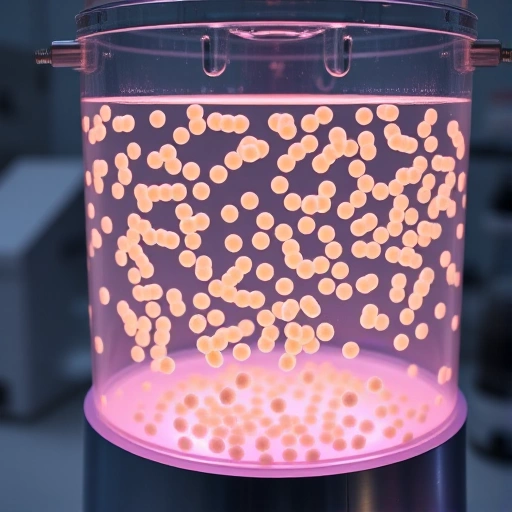
Figure: E. coli culture in laboratory bioreactor (AI-generated representative image)
The Challenge: Taming a Complex Biosynthetic Beast
Let me set the stage for you. Flavonoids like naringenin represent a class of over 9,000 specialized plant metabolites with diverse biological activities. These compounds have captured industrial attention for their potential in everything from anti-inflammatory drugs to natural food colorants. However, producing them microbially is no walk in the park. The heterologous pathway requires four non-native enzymes—tyrosine ammonia-lyase (TAL), 4-coumaroyl-CoA ligase (4CL), chalcone synthase (CHS), and chalcone isomerase (CHI)—to convert the native E. coli metabolites L-tyrosine and malonyl-CoA into naringenin.
Here's where things get complicated, and I want to emphasize just how complicated. Each enzymatic step in such a pathway can be controlled by different promoters, ribosome binding sites (RBSs), enzyme variants, and terminators. The combinatorial explosion is staggering—the number of possible pathway variants follows the formula: (promoters × RBSs × enzyme variants × terminators)^(number of operons). With even modest numbers, you're looking at thousands to millions of possible configurations. Finding the "metabolic sweet spot" manually is like searching for a needle in a haystack the size of a galaxy.
Traditional approaches have struggled with this complexity. Sequential optimization, where you tune one gene at a time, fails to capture the intricate interplay between pathway steps. Balanced expression is crucial—too little enzyme activity creates bottlenecks, while too much creates metabolic burden that cripples the host cell. What we need, and what this paper delivers, is a way to explore this vast design space intelligently and efficiently.
The Innovation: Orthogonal Expression as a Master Control System
The foundation of this work rests on a brilliant concept called orthogonal gene expression. Think of it as creating a parallel regulatory system that operates independently of the host's native machinery. The researchers leveraged a sigma factor (σ) toolbox previously developed by Bervoets et al. (2018), which uses heterologous sigma factors from Bacillus subtilis to drive transcription from dedicated promoter sets without cross-talk with E. coli's native transcriptional network.
I suggest you visualize this as installing a separate circuit breaker panel in your house—the main electrical system continues to run your lights and appliances, while the new panel controls a specialized industrial machine. This orthogonal system allows precise, independent tuning of each pathway module without unpredictable interference from the host's regulatory responses. It's synthetic biology at its most elegant: creating order in biological chaos.
For the naringenin pathway, the team implemented four catalytic steps under the control of σ^B from Bacillus subtilis. Each gene could be expressed using one of ten promoter variants with different transcription initiation frequencies (TIFs), and for each enzyme, two different coding sequences (CDSs) from different plant or microbial sources were available. This created a manageable yet diverse library of pathway variants to test.
Building the Library: Combinatorial Assembly Meets Smart Screening
The experimental workflow itself is a testament to modern synthetic biology's sophistication. Using a Golden Gate assembly method with unique linker sequences, the researchers created carrier plasmid libraries for each pathway step. Each library contained variants with different promoter-enzyme combinations. These were then assembled into complete pathways through a one-pot, parallel assembly reaction—imagine throwing all the puzzle pieces into a box and having them magically come together in the right order thousands of times simultaneously.
This assembly mix was transformed into an E. coli strain that harbored the heterologous σ^B factor integrated into its genome. But here's the clever part: the team also equipped these cells with a naringenin-responsive biosensor that produces fluorescence in proportion to naringenin concentration. This transformed the screening process from a laborious, step-by-step analytical chemistry nightmare into a high-throughput fluorescence measurement that could be performed on thousands of colonies using fluorescence-activated cell sorting (FACS).
From an initial library, they selected 35 strains that spanned the entire range of fluorescence intensities. This strategic selection maximized information content—rather than randomly picking clones or just taking the top performers, they ensured their dataset would capture the full spectrum of pathway performance. I find this approach particularly insightful because it provides the rich, varied data needed to train predictive models effectively.
These 35 strains were then characterized individually using ultra-performance liquid chromatography (UPLC) to measure actual naringenin titers, which ranged from a modest 1.52 mg/L to an impressive 27.03 mg/L. Simultaneously, sequencing revealed the exact promoter and enzyme variant combinations present in each strain. This genotype-phenotype mapping became the foundation for their computational wizardry.
Data Exploration: Finding Patterns in the Noise
Before building predictive models, the team performed careful data exploration—a step I cannot emphasize enough in its importance. They converted promoter labels into continuous TIF values based on previous characterization data, allowing them to treat promoter strength as a quantitative variable rather than a categorical one.
Initial analysis revealed intriguing correlations. While not all reached statistical significance after multiple testing correction, the data suggested positive correlations between naringenin titer and promoter strength for the first (TAL) and third (CHS) enzymatic steps, but a negative correlation for the second step (4CL). This hints at a delicate balance—pushing the pathway too hard at the 4CL step might create a bottleneck or metabolic burden downstream.
The enzyme variant analysis yielded even clearer insights. Through one-way ANOVA, they found that pathways containing the TAL enzyme from Flavobacterium johnsoniae (FjTAL) significantly outperformed those with the Rhodotorula glutinis variant (RgTAL). For the other enzymes, the trends were less pronounced, though certain combinations showed promise. What strikes me here is how this simple statistical test can guide rational design—why waste time on inferior enzyme variants when the data clearly points to a superior choice?
The Three-Pronged Computational Approach: OLS, PLS, and ANN
This is where the research truly shines. Rather than relying on a single modeling approach, the team built and compared three different predictive models, each with distinct strengths. I want to emphasize that this multi-model strategy provides robustness—if different methodologies converge on similar predictions, you can be much more confident in the results.
Ordinary Least Squares Regression: The Classical Workhorse
First, they employed ordinary least squares (OLS) regression, a straightforward linear modeling technique. Starting with a full model that included all promoter and enzyme variant terms, they systematically removed the least significant terms to arrive at a final, parsimonious model. The resulting model explained the data reasonably well (R² = 0.62) and identified key predictors: high expression of Petroselinum crispum 4CL (Pc4CL) and Petunia hybrida CHI (PhCHI), combined with low expression of Gerbera hybrida CHS (GhCHS), could theoretically achieve titers up to 61.2 mg/L.
I find it reassuring that even this relatively simple linear model could capture meaningful relationships. It suggests that while biology is complex, some aspects of pathway performance follow predictable, monotonic patterns that don't require deep learning to understand.
Partial Least Squares Regression: Handling Multicollinearity
Recognizing that biological data often suffers from multicollinearity—where predictor variables are correlated with each other—the team also employed partial least squares (PLS) regression. This technique is particularly suited for situations with many features but relatively few observations, exactly the scenario we face in synthetic biology.
The PLS model, using two latent variables, performed similarly to OLS but through a different mathematical lens. It identified the same top-performing strain configurations, which I see as strong validation. When two independent modeling approaches point to the same solution, you're likely onto something real rather than a statistical artifact.
Artificial Neural Network Ensemble: The Deep Learning Frontier
Finally, they implemented a machine learning workflow adapted from Zhou et al. (2018), using an ensemble of artificial neural networks (ANNs). This approach treats each promoter and enzyme variant as binary input features (present or absent) and trains multiple ANN iterations to predict naringenin titer. The ensemble nature—running 1000 iterations with random initializations—helps overcome the overfitting risk that plagues small-sample deep learning.
What I find particularly clever is their selection criterion: they tracked which pathway configurations appeared most frequently in the top 10 predictions across all iterations, then selected those that exceeded a frequency threshold. This consensus approach is robust against the stochastic nature of neural network training.
The ANN ensemble predicted six top candidates (Top10.1 through Top10.6), three of which overlapped with the PLS predictions—another reassuring convergence. In my opinion, this multi-model agreement is the computational equivalent of triangulation in navigation; it gives you confidence in your position.
Experimental Validation: Where Predictions Meet Reality
The true test of any model is its ability to predict outcomes it hasn't seen. The researchers constructed the six ANN-predicted strains and measured their performance. The results were both validating and revealing.
The top three strains from the initial biosensor screening (135, 220, and 133) produced 16.12, 11.05, and 8.92 mg/L respectively in validation experiments—noticeably lower than their initial screening values, likely due to biological variability and the absence of the biosensor plasmid during production. This highlights a critical point I want to emphasize: screening conditions and production conditions must be carefully matched for predictions to hold.
The model-predicted strains told a more interesting story. Top10.4 and Top10.5 emerged as the clear winners, producing 44.71 and 37.32 mg/L respectively—a dramatic improvement over the best screening strain. However, not all predictions panned out; Top10.2 and Top10.3 showed high variability and lower average titers, with some replicates identified as statistical outliers.
This outlier pattern proved insightful. Strains with very high promoter strengths (B9 or higher) for both FjTAL and GhCHS showed erratic performance, suggesting metabolic burden. When the cell diverts too many resources toward expressing heterologous enzymes, its own viability suffers, leading to unpredictable production. Comparing Top10.4 with Top10.2 (which differs only in higher FjTAL expression) showed that increased TAL expression actually decreased performance, confirming that more isn't always better.
The Best Strain: A Batch Bioreactor Triumph
The pièce de résistance came when the top-performing strain, Top10.4, was cultured in a controlled batch bioreactor. After approximately 26 hours, this engineered microbe produced 286 mg/L of naringenin from glycerol as the sole carbon source. Let me put this in perspective: this is the highest reported naringenin titer in E. coli without precursor supplementation or extensive host engineering.
The bioreactor data revealed fascinating dynamics. During exponential growth, naringenin accumulated steadily while p-coumaric acid (the intermediate after the TAL step) remained low, indicating a well-balanced pathway. However, upon entering stationary phase, naringenin production ceased and p-coumaric acid began accumulating. This suggests that malonyl-CoA availability became limiting—a classic case where the cell's central metabolism can't keep up with the heterologous pathway demand.
The specific production rate reached 20.8 mg naringenin per gram cell dry weight per hour, with a yield of 62.9 mg per gram biomass. These metrics are impressive for a heterologous pathway, especially one that hasn't been integrated into the host's metabolism through extensive genome editing.
Comparative Analysis: Glycerol vs. Glucose, Optimized vs. Unoptimized
To contextualize their achievement, the team compared Top10.4 and Top10.5 against a reference strain (NarRef) expressing an unoptimized pathway with identical promoters for all genes. The results were stark: the optimized strains produced roughly double the naringenin on both glucose and glycerol media.
Interestingly, glycerol outperformed glucose as a carbon source, likely because glycerol metabolism provides more abundant NADPH and acetyl-CoA precursors for malonyl-CoA synthesis. This is a practical insight for industrial scale-up, as glycerol is also a cheap byproduct of biodiesel production.
The reference strain also accumulated significant p-coumaric acid, indicating a bottleneck at the CHS step. In contrast, the optimized strains maintained low intermediate levels, demonstrating that balanced expression prevents both substrate limitation and toxic intermediate buildup. I find this particularly elegant—good pathway design isn't just about maximizing end product, but about maintaining metabolic harmony.
The Metabolic Burden Dilemma: When Too Much of a Good Thing Becomes Bad
One of the most valuable insights from this work concerns metabolic burden. The researchers observed that strains with very high expression of both FjTAL and GhCHS became unstable, showing filamentation and stress responses. This manifests in the data as high variability and outlier replicates.
I suggest that this phenomenon reveals a fundamental principle of metabolic engineering: enzyme expression must be optimized, not maximized. Our intuition often pushes us toward "more enzyme = more product," but biology imposes constraints. Each heterologous protein expressed consumes cellular resources—ribosomes, amino acids, ATP, NADPH—and misfolded proteins trigger stress responses. The optimal pathway is one that pushes production as high as possible while keeping the host cell healthy and productive.
The negative correlation between 4CL promoter strength and titer further supports this view. Overexpressing the second enzyme in the pathway may drain the p-coumaric acid pool too rapidly, creating a metabolic sink that
Citation
Maarten Van Brempt and Andries Ivo Peeters and Dries Duchi and Lien De Wannemaeker and Jo Maertens and Brecht De Paepe and Marjan De Mey. (2022). Biosensor-driven, model-based optimization of the orthogonally expressed naringenin biosynthesis pathway.. Microbial cell factories. DOI: 10.1186/s12934-022-01775-8